I-Flex / 2026
Figma
Claude
Secondary Research
Product Design
AI Guidelines
Challenge
Freelancers kept asking for better budgeting.
But budgets assume a paycheck. Irregular earners don’t have one. So the question wasn’t how do we build a better budget. It was: can an app be honest about money it can’t predict?
Approach
This came from a finding, not a hunch. I analyzed 2,461 real transactions, data set was taken from kaggle across 45 months: the best month was 84× the worst, spending outran income twice a year, and a simple forecast missed by 25%+ one month in three.
So I-Flex never pretends to certainty. It forecasts in ranges, automates inside user-set fences, and shows the receipts behind every claim.
Not replacing judgment. Meeting it halfway
Prototype
User Journey
Building on the documented journey, I reorganized Raj’s money month around the app.
The journey drops from 4 phases to 3 — the Famine phase disappears as a distinct crisis, absorbed into planning — and 7 of the 10 friction actions are automated or answered by I-Flex.
Raj’s remaining work: confirm, decide, and adjust — never compute.

Target Persona
Raj's income swings 3× month to month — his anxiety is planning.
Priya's arrives on the 1st — hers is deciding what windfalls become.
Persona
Lean-month survival
Guilt over spending
Planning the unknown
50%
30%
20%
Raj


Persona
Windfall decisions
Set-and-forget
Buffer building
35%
45%
20%
Priya
Data Analysis


My first research pass was a 15-person survey — honest, but thin. So I pressure-tested I-Flex’s assumptions against real money: 2,461 transactions from an Indian household’s diary, spanning 45 months (Daily Household Transactions, Kaggle).
The numbers decided which parts of the concept held up.
Monthly income swung from ₹3,500 to ₹2.9 lakh — the best month was 84× the worst. And this is a mostly salaried household; the freelancer version of this chart is strictly worse. The design consequence: any single-number forecast is a lie waiting to be discovered.
Shortfalls hit in 7 of 45 months — roughly twice a year, every year. Not emergencies; a season. This reframed the buffer from a nice-to-have into infrastructure, and it’s why I-Flex measures the buffer in lean months covered, not rupees.
A 3-month rolling forecast looks trustworthy — median error just 11%. But it misses by more than 25% in one of every three months, and by 1,900% in the worst. The design requirement that fell out: forecasts must be ranges, and the range must widen when income gets jumpy. (This finding became HAX G2 rendered as geometry — the band chart in Chapter 2.)
Wireframing
Onboarding
Sign in
First Name
Email Address
Last Name
Create Password
I agree to the terms and privacy policy
Already a member? Login
Or continue with

Create your account in a seconds
Start saving
9:41
Enable Face ID
With Face ID, you won’t need to enter your password every time. This helps make the app more secure and login easier.
Enable
Not now
9:41
Connect bank account
Through India's RBI-regulated Account Aggregator, I-Flex reads your transaction history to learn your income pattern and power your Smoother.
You're giving I-Flex read-only access to your account activity via the Account Aggregator framework. We use it to understand your income, commitments, and spending pattern — this shapes your forecast, your savings rule, and your insights. Read-only means exactly that: we can see transactions, we can never move money without a rule you've set and approved. You can view, pause, or revoke this consent anytime in Settings → Data & Consent. Revoking stops all forecasts and rules immediately. See our Privacy Policy for what we store and for how long.
Step 1 of 2
Cancel
Link my bank
Not now
9:41
A few honest agreements
I agree to the Terms of Service and understand my I-Flex subscription renews at ₹199/mo (or ₹1,499/yr) after the 30-day free trial. Cancel anytime in the app — cancelling takes two taps, not a phone call.
I authorize automatic transfers ONLY under rules I create, with floors and ceilings I set. I-Flex never initiates a transfer outside my rule, and every transfer appears in my activity the moment it happens.
Step 2 of 2
Cancel
Set up my smoother
9:41
ICICI Bank
Details
Mobbin bank
Account name
IFSC code
Account no.
Branch
Ravi Krishna
ICICI bank
658************
Kothrud, Pune
Cancel
Connect account
9:41
Saving that survives lean months
I-Flex moves money to your buffer automatically — saving more in strong months, pausing in lean ones. You set the fences; it works between them.
Saves from income above your ceiling, pauses below your floor — you'll build a buffer without ever squeezing a lean month.
Your outlook is shown as a range, not a guess dressed as a fact — and it warns you early when a month looks lean.
Cancel
Start saving



9:41
Safe to Spend

9:41
Habit tracker
This is what's left after rent, EMIs, subscriptions, and the buffer you've set aside. It updates as money moves.
Good morning,
Raj

Safe to Spend
₹42,600
after commitments & buffer
Income & Forecast
Actual
Forecast
Feb
Mar
Apr
May
Jun
Jul
Aug
Sep
Oct
COMMITMENTS
₹42,600 is safe to spend till August — September may run lean. Plan ahead

Covers 0.6 lean months
Your Income Smoother Plan
Link Your Account
See your pattern
Set your Smoother
We read your last 12 months — nothing moves without you
Your real income highs, lows, and lean months — shown before we suggest anything
You set the floor and ceiling; saving adjusts between them automatically
Based on your income pattern and buffer goal
Honest forecasts
Auto-save with fences
Show me my pattern
Buffer: ₹18,400
9:41
Your Income Smoother Plan
Link Your Account
See your pattern
Set your Smoother
We read your last 12 months — nothing moves without you
Your real income highs, lows, and lean months — shown before we suggest anything
You set the floor and ceiling; saving adjusts between them automatically
Based on your income pattern and buffer goal
Honest forecasts
Auto-save with fences
Show me my pattern
Habit tracker
Football turf
5
1
5
Cafe
Tea
₹ 450
₹ 650
₹ 120
per week
per week
per week
These feed your Safe-to-Spend — the AI counts them in, and flags the ones worth trimming in lean months.
All fit comfortably
₹1,220/week across 3 habits · all fit comfortably this month
Safe spend
Flexible left for Sep: ₹3,600
9:41
Football turf
5
1
5
Cafe
Tea
₹ 450
₹ 650
₹ 120
per week
per week
per week
This is what's left after rent, EMIs, subscriptions, and the buffer you've set aside. It updates as money moves.
₹42,600 is safe to spend till August — September may run lean. Plan ahead
Covers 0.6 lean months
Income Smoother
Your Income Smoother Plan
Link Your Account
See your pattern
Set your Smoother
We read your last 12 months — nothing moves without you
Your real income highs, lows, and lean months — shown before we suggest anything
You set the floor and ceiling; saving adjusts between them automatically
Based on your income pattern and buffer goal
Pause
Honest forecasts
Auto-save with fences
Show me my pattern
Buffer: ₹18,400
Habit
Coffee
Spend
₹ 250
Frequency
6 times in a week
Add
Cancel
Once added, this counts against your Safe-to-Spend — and the AI will tell you exactly what
skipping it earns you in a lean month.
Habit tracker
₹1,220/week across 3 habits · all fit comfortably this month
9:41
Football turf
5
1
5
Cafe
Tea
₹ 450
₹ 650
₹ 120
per week
per week
per week
This is what's left after rent, EMIs, subscriptions, and the buffer you've set aside. It updates as money moves.
₹42,600 is safe to spend till August — September may run lean. Plan ahead
Covers 0.6 lean months
Income Smoother
Your Income Smoother Plan
Link Your Account
See your pattern
Set your Smoother
We read your last 12 months — nothing moves without you
Your real income highs, lows, and lean months — shown before we suggest anything
You set the floor and ceiling; saving adjusts between them automatically
Based on your income pattern and buffer goal
Pause
Honest forecasts
Auto-save with fences
Show me my pattern
Buffer: ₹18,400
Coffee added. That's ₹6,000/month at this pace — your Safe-to-Spend just updated.
Habit tracker
₹1,220/week across 3 habits · all fit comfortably this month
9:41
Moodboard and Illustrations

Safe-to-Spend — what’s yours to spend, today

The rollercoaster, bridged — income's shape, and the app spanning its gaps


The Smoother — saves in feast, pauses in famine

The buffer, filling — coverage measured in lean months, not rupees

Lean months, sheltered — protection, not panic
Before wireframing, I collected UI patterns from fintech and AI-native apps — not for their visuals, but for interaction mechanics worth adapting.
Cleo — the onboarding plan card (stepper + chips + single CTA) shaped the Smoother setup flow; the chat-first home screen shaped Ask — restructured to drop the personality and add a scope contract, since I-Flex’s AI answers, it doesn’t chat.
Oportun — the consent-and-review flow (Connect → Review agreements → Value prop) shaped the account-linking screens, rewritten for India’s Account Aggregator framework and for plainer, less legalese-heavy consent language.
Mobbin fintech collection — general reference for goal cards, progress bars, and transaction-list density across apps like CRED, Jupiter, and Fold.
What I borrowed vs. rejected: structure over skin, every time. Card layouts, stepper patterns, and information density were worth adapting; tone was not — gamified language, streaks, roasts, and urgency copy were rejected wherever they contradicted I-Flex’s calm, non-judgmental register.
Chapter 1
Forecasts that tell the truth

The app never issues instructions about the user's life — it prices the trade and lets him decide (your G11/receipts pattern, and the no-shame rule). "You will need to" is a command; "frees ₹1,040" is an offer.

The Forecast page is volatility-responsive: for a steady earner it quiets itself down to a three-second glance — the same components, turned down. An honest forecasting tool must be as calm about good news as it is early about bad.

The AI never says "cut this" — it prices the trade ("skipping 1 frees ₹130") and connects it to a goal the user already has (September's gap), which is HAX G11 and your receipts pattern doing sales work.

The UI changes when the months ahead are comfortable
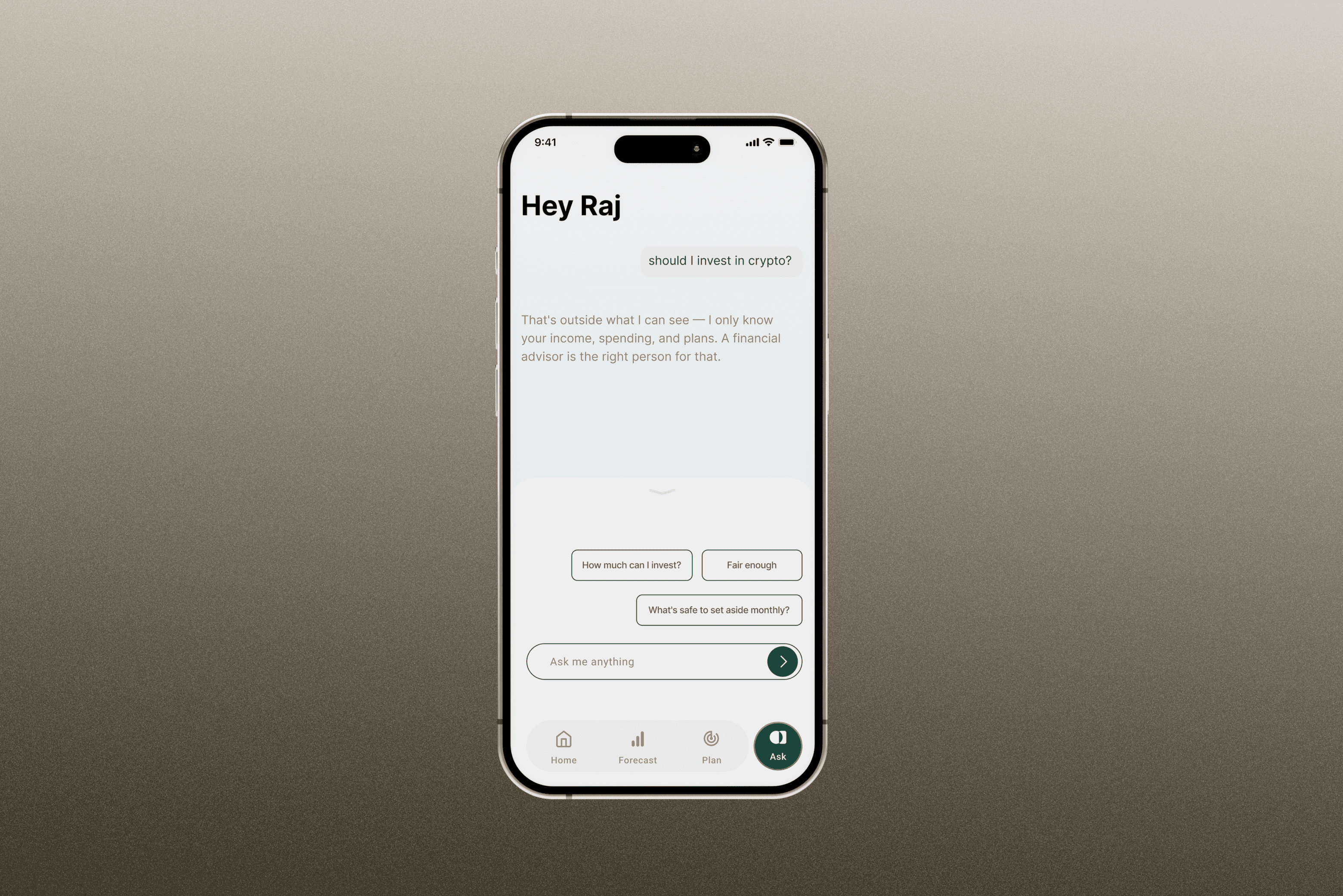
Out-of-scope questions get a decline plus a bridge — the AI never pretends to expertise it lacks
(HAX G1), but it also never leaves the user at a dead end. The no-dead-ends rule from the loan journey applies to conversations too.”
Chapter 2
Forecasts that tell the truth

One number answers the daily question
Safe-to-Spend is computed after commitments and buffer — not the bank balance, which lies to irregular earners. The amber banner names the safe window and the lean month in one breath, and it’s a door: tap to plan, not just a warning.
The forecast bars ahead are ranges, not promises — HAX G2: make clear how well the system can do what it does.

Tap any month, see the working.
Past months show their receipts — every rupee names its source (₹45,000 from Acme, ₹18,000 retainer). Future months explain their uncertainty: which income is steady, which is jumpy, and why the range is wide.
A forecast that shows its ingredients can be corrected — and trusted. Shape of AI: transparency HAX G11: make clear why the system did what it did.
Chapter 3
Ask
Home
Forecast
Plan
Ask
Ask me anything
Why is my range wide?
Can I afford ₹8,000 this month?
What's my September plan?
Hey Raj
Ask about your money
I can see your income, spending, habits, and plans — and I'll show the numbers behind every answer. Here's what I'm noticing right now:
Your September gap is down to ₹9,200 · food delivery ran higher than usual this week
9:41
1
Home
Forecast
Plan
Ask
Why is my range wide?
Why is my range wide?
Can I afford ₹8,000 this month?
What's my September plan?
Hey Raj
Ask about your money
I can see your income, spending, habits, and plans — and I'll show the numbers behind every answer. Here's what I'm noticing right now:
Your September gap is down to ₹9,200 · food delivery ran higher than usual this week
9:41
2
Home
Forecast
Plan
Ask
Ask me anything
Show the 9 orders
Is this a problem?
Confirm my commitments
Hey Raj
Food delivery ran ₹2,340 this week across 9 orders — about double your usual. Tap to see the transactions.
One thing missing: your commitments aren't set up yet, so your Safe-to-Spend can't be accurate. Two minutes to add rent and EMIs?
9:41
3
Home
Forecast
Plan
Ask
Ask me anything
Hey Raj
That's outside what I can see — I only know your income, spending, and plans. A financial advisor is the right person for that.
should I invest in crypto?
How much can I invest?
Fair enough
What's safe to set aside monthly?
4
1
It starts with a contract, not a greeting
The first message states what the AI can see — income, spending, habits, plans — and promises receipts with every answer. No wave emoji, no personality. The scope is the introduction. HAX G1: make clear what the system can do.
3
Noticing without judging
“Food delivery ran ₹2,340 — about double your usual”. Same specificity, zero editorializing. Spending is data, never a personality trait. And the nudge carries its reason — your Safe-to-Spend can’t be accurate until commitments are confirmed.
2
Chips are promises
Every suggested question maps to an answer the system can actually render with evidence. The conversation is bounded to what the app truly knows — a conversational index into the receipts, not a new brain.
4
Declines come with a bridge.
Asked about crypto, the AI names its boundary and hands over what it does know: how much is genuinely spare. No pretended expertise, no dead end — the no-dead-ends rule from the loan journey, applied to conversation. HAX G1 · PAIR: setting expectations.
AI Principles Used
I-Flex uses AI in exactly three ways. Predict. Search. Personalize.
It never chats. It answers when asked, and stays silent otherwise.
Every prediction is a range, never a single confident number.
Every automation works only between fences the user sets.
Every suggestion shows its receipts — the transactions behind the claim.
None of this came from taste alone.
It leans on three published frameworks: Microsoft’s HAX guidelines, Google’s People + AI Guidebook, and the Shape of AI pattern library.
The key decision was this: an AI that knows when to stay quiet is worth more than one that always has something to say.
Conclusion
I-Flex started as a hunch about freelancers and a 15-person survey.
It became sturdier once I pressure-tested it against real money — 2,461 transactions across 45 months.
Income swung 84× between its best and worst months. Shortfalls arrived twice a year, like clockwork. A simple forecast failed one month in three.
Testing it against real money reshaped what I believed, and the design that came out is more honest for it.
What came out the other side is a small grammar, applied everywhere. Predicted numbers are ranges. User-controlled numbers are exact. Automation works only between fences the user sets.
The key decision was to never show a number the app couldn’t stand behind.
Instead of forecasting with false confidence, the system ranges, explains, and stays quiet when there’s nothing to say. This makes the numbers slower to distrust, and far more useful when it matters.
©2024 All Rights Reserved by Siddharth Gore Design