I-Flex / 2026
Figma
Claude
Secondary Research
Product Design
AI Guidelines
Role
Product Designer
Tools
Figma · Claude
Research
2,461 transactions · 45 months
Frameworks
HAX · PAIR · Shape of AI
Challenge & Approach
84×
Best month vs worst month, across 45 months of real data.
2× a year
Spending outran income, like a season, not an emergency.
1 in 3
Months where a simple forecast missed by 25% or more.
So I‑Flex never pretends to certainty
Forecasts in ranges
Every prediction is a band, never a confident single number.
Automates inside fences
Saving moves only between the floor and ceiling you set.
Shows the receipts
Every claim links to the transactions behind it.
Not replacing judgment. Meeting it halfway.
User Journey
Building on the documented journey, I reorganised Raj’s money month around the app. The journey drops from 4 phases to 3, the Famine phase is absorbed into planning, and 7 of the 10 friction actions are automated or answered by I‑Flex.
Raj’s remaining work
Confirm, decide and adjust. Never compute.

A crisis phase became a calendar event.
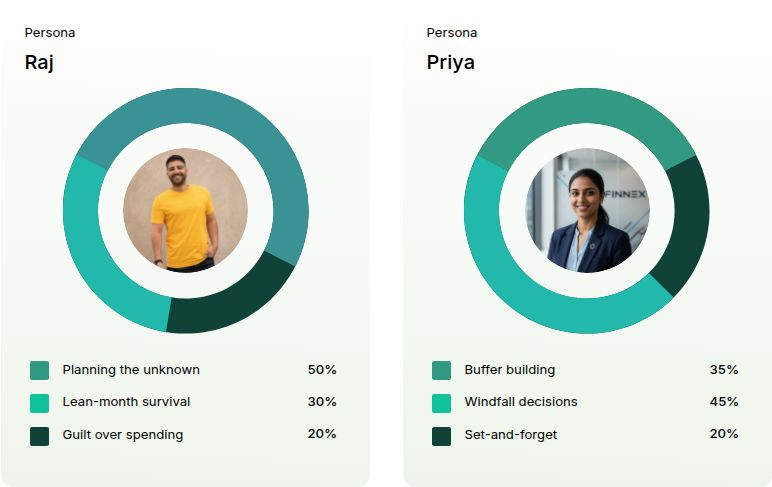
Target Personas
Data Analysis

Income isn’t a line
Monthly income swung from ₹3,500 to ₹2.9 lakh. Any single‑number forecast is a lie waiting to be discovered.

Shortfalls are a season
Spending outran income in 7 of 45 months. The buffer became infrastructure, measured in lean months covered.

Forecasts must be ranges
A rolling forecast missed by 25%+ one month in three, so the range widens when income gets jumpy.
Wireframing


Moodboard & Illustrations

Safe‑to‑Spend: what’s yours to spend, today

The rollercoaster, bridged: income’s shape, and the app spanning its gaps

The Smoother: saves in feast, pauses in famine

The buffer, filling: coverage in lean months, not rupees

Lean months, sheltered: protection, not panic
Before wireframing, I collected patterns from fintech and AI‑native apps like Cleo and Oportun, borrowing structure over skin. Card layouts, steppers and information density were worth adapting. Gamified language, streaks and urgency copy were rejected wherever they broke I‑Flex’s calm, non‑judgmental tone.
Chapter 1 · Forecasts that tell the truth

Lean month ahead?
The app never issues instructions about your life. It prices the trade and lets you decide. “You will need to” is a command; “frees ₹1,040” is an offer.

Comfortable path ahead?
The Forecast page is volatility‑responsive. For a steady earner it quiets down to a three‑second glance: the same components, turned down.

The AI never says “cut this”
It prices the trade (“skipping 1 frees ₹130”) and connects it to a goal you already have.

Calm about good news
The UI changes when the months ahead are comfortable, as calm about good news as it is early about bad.
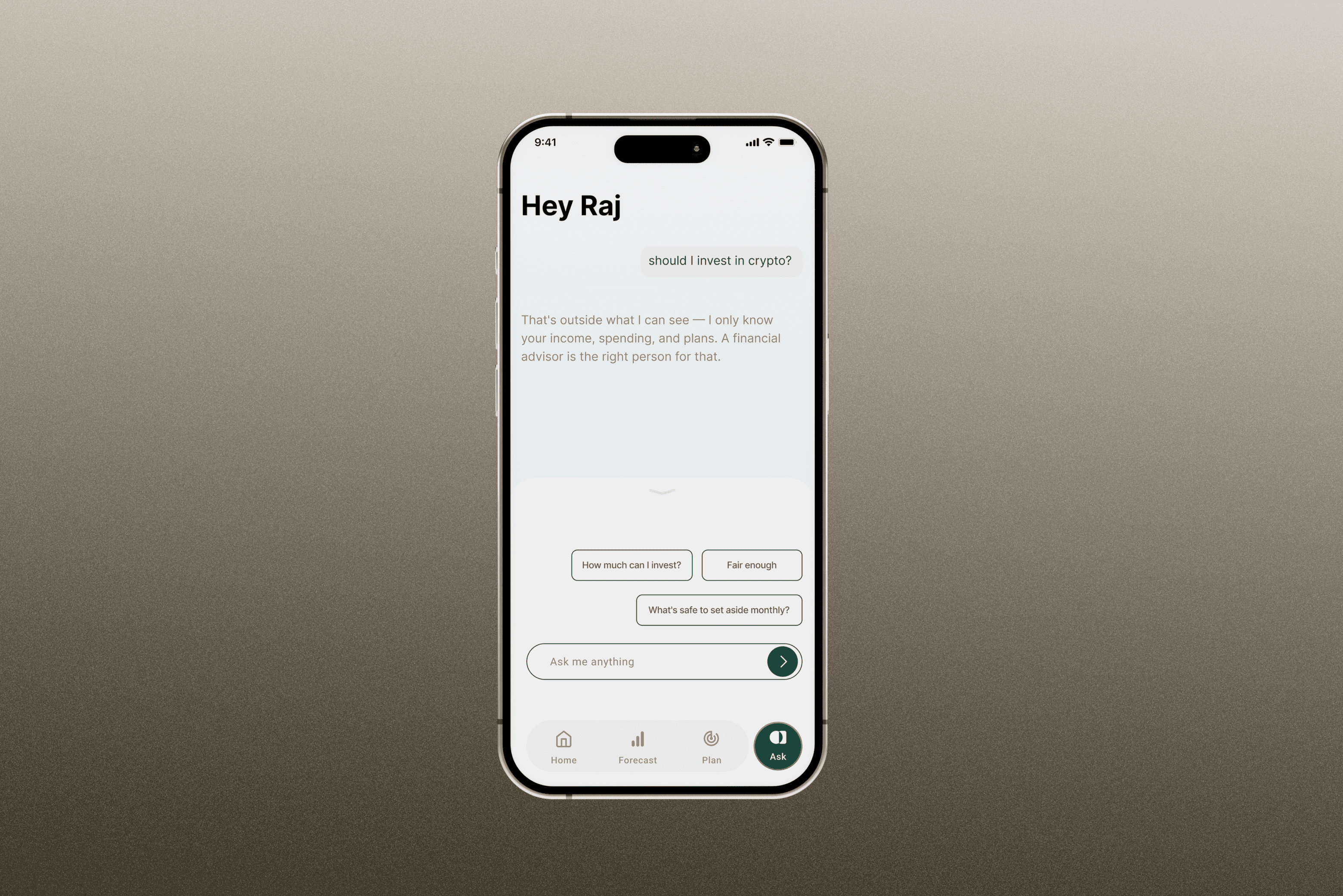
Out‑of‑scope questions get a decline plus a bridge. The AI never pretends to expertise it lacks, and never leaves you at a dead end.
Chapter 2 · One number answers the daily question

Safe‑to‑Spend
Computed after commitments and buffer, not the bank balance, which lies to irregular earners. Forecast bars ahead are ranges, not promises.

Tap any month, see the working
Past months show their receipts. Future months explain their uncertainty. A forecast that shows its ingredients can be corrected, and trusted.
Chapter 3 · Ask

1
It starts with a contract, not a greeting
The first message states what the AI can see and promises receipts with every answer. No wave emoji, no personality.
2
Chips are promises
Every suggested question maps to an answer the system can render with evidence.
3
Noticing without judging
“Food delivery ran ₹2,340, about double your usual.” Spending is data, never a personality trait.
4
Declines come with a bridge
Asked about crypto, the AI names its boundary and hands over what it does know: how much is genuinely spare.
AI Principles
I‑Flex uses AI in exactly three ways
It never chats. It answers when asked, and stays silent otherwise. Built on Microsoft’s HAX guidelines, Google’s People + AI Guidebook and the Shape of AI pattern library.
“An AI that knows when to stay quiet is worth more than one that always has something to say.”
Conclusion
I‑Flex started as a hunch and a 15‑person survey, and became sturdier once tested against real money. One of my own assumptions didn’t survive, and losing it taught me more than the ones that did. What came out is a small grammar applied everywhere: predicted numbers are ranges, user‑controlled numbers are exact, and automation works only between fences the user sets.